Polyvagal Theory
.png)
Polyvagal Theory — The Science of Safety and Regulation
Most men think their reactions are about willpower—“I just need to control myself.”
But your body isn’t asking for control. It’s asking for safety.
Polyvagal Theory explains how your nervous system drives everything: your emotions, your relationships, even your faith walk.
The Three States of the Nervous System
Your nervous system is like a ladder — and you’re always somewhere on it.
At the top, there’s too much energy (fight or flight).
At the bottom, there’s too little (freeze or shutdown).
And right in the middle is your window of tolerance — the place of safety, balance, and connection.
What “Autonomic” Really Means
This ladder is part of your autonomic nervous system — “autonomic” meaning automatic.
You don’t control it — it controls you.
It’s the part of your body that runs in the background 24/7, constantly adjusting how alert, calm, or shut down you feel without asking for your permission.
The Body’s Constant Scan
Your body moves between these states based on whether it senses safety or danger.
That process is called neuroception — your nervous system’s ability to perceive threat or safety even before your conscious mind does.
It’s always scanning your environment, your body, and even the tone of someone’s voice, asking one question:
Am I safe, or am I in danger?

The Ladder of the Nervous System
Your Nervous System Doesn’t Always Get It Right
Here’s what’s extremely important to know:
-
Your nervous system isn’t perfect.
It’s designed to keep you alive, not necessarily to tell the truth about what’s actually happening.

From Saber-Toothed Tigers to Modern Stress
Back in ancient times, this system kept us alive.
If a saber-toothed tiger appeared, your body didn’t wait to think — it reacted instantly: fight, flee, or freeze.
But in the modern world, those same survival circuits still fire — even when the “threat” isn’t life-or-death.
Now it might be being late for a job interview, getting a harsh text from your wife, or feeling criticized at work.
Your nervous system can misread these moments, flooding you with the same panic or shame as if your life were in danger.
It says, “You’re unsafe!” — even when you actually are.
.png)
.png)
What “Neuroception” Really Means
That’s why it’s called neuroception — because it’s your nervous system’s perception of threat or safety.
It doesn’t mean it’s always accurate.
Your body is scanning your environment every second — tone of voice, facial expressions, posture, even silence — deciding:
Am I safe, or am I in danger?
But that decision happens beneath awareness, and sometimes it gets it wrong.
When Black-and-White Thinking Shows Up
So when you catch yourself thinking in extremes —
“She doesn’t care about me.”
“I’m a failure.”
“It’s over.” —
those aren’t “truths.”
They’re signs that you’re outside your window of tolerance, caught in fight/flight or shutdown.
You’re no longer grounded in connection — your body’s running old survival code.

The Power of Awareness
When you can notice this shift, you gain real power.
Not by shaming yourself, but by realizing:
This isn’t reality. It’s my dysregulated nervous system trying to protect me.
That awareness is the doorway back to regulation — back to presence, truth, and connection.

DEEP DIVE
14 . Gospel of the Nervous System: Scripture as the Original Regulation Map (⭐Featured Core Section)
-
Genesis 3: Shame and dorsal collapse — God’s first co-regulating question, “Where are you?”
-
Exodus: Deliverance as physiological awakening — the Red Sea as the great exhale of liberation.
-
1 Kings 19: Elijah’s burnout healed through rest, food, and the “still small voice.”
-
Psalms: Emotional regulation in real time — turning panic into praise.
-
The Gospels: Jesus restores safety through touch, tone, and attunement.
-
Acts: The Spirit breathes shared ventral connection — safety in community.
-
Revelation: Complete integration — no more threat, only peace.
Core Revelation
-
“The Word became flesh — truth became nervous system, safety became sacred.”
-
Reading Scripture through a ventral lens transforms theology from theory into embodiment.
-
Practice: Before reading, breathe. Ask: “Where is safety? Where is love regulating this moment?”
-
“This is the Gospel of the Nervous System — the story of God bringing humanity home one regulated breath at a time.”
15. The Journey Home: From Science to Spirit
-
Polyvagal Theory reveals that every act of regulation is a return to relationship — with God, self, and others.
-
Section I: Foundation — understanding your system and learning your ventral blends.
-
Section II: Safety in Motion — telling energy from threat and staying connected in intensity.
-
Section III: Sensory Awareness — how music, sound, and texting expose your regulation map.
-
Section IV: Embodied Regulation — ordinary acts as sacred rituals of grounding and flow.
-
Section V: Revelation — how the science of safety becomes spiritual clarity and creativity.
-
Section VI: The Gospel of the Nervous System — Scripture as the nervous system’s redemption story.
Core Takeaway
-
Regulation isn’t self-help — it’s discipleship of the body.
-
Healing is worship. Safety is sacred. Presence is prayer.
-
The full circle: understanding → embodiment → revelation → integration → peace.
-
“This is what it means to be Calm in the Storm.”
Glossary
-
What “Safety” Actually Means
-
Definition of safety as connection, not just the absence of threat.
-
Intro to ventral blends — how each person’s nervous system creates a unique map of safety.
2. The Three Ventral Blends
-
Pure Ventral – The Open Heart
-
Ventral–Sympathetic – The Engaged Leader
-
Ventral–Dorsal – The Quiet Anchor
-
Includes how to identify your “anchor blend” and how to flex between them.
3. Why This Matters
-
Knowing your blend builds emotional agility.
-
True regulation = traveling between states and returning home easily.
4. Reflect & Apply
-
Knowing your blend builds emotional agility.
-
True regulation = traveling between states and returning home easily.
5. The Difference Between Energy and Threat
-
Ventral Sympathetic vs. Triggered Sympathetic.
-
Fire without fear vs. fight from fear.
-
Includes quick compass: “Am I connected or defending?”
6. Why Regulation Feels Unsafe to the Unregulated
-
How calm can look threatening to dysregulated people.
-
“Your peace will look suspicious in a reactive world.”
-
Reflection prompts and leadership insights.
7. Attuned Communication: Matching Nervous Systems Before You Speak
-
Understanding state mismatch in conversation.
-
3-step check before sharing something emotional or visionary.
-
Emotional stewardship and attuned expression as spiritual maturity.
8 . Music as a Mirror (How Sound Reveals Your Nervous System’s Story)
-
How sound, rhythm, and tone mirror internal states.
-
“Your playlists are your Polyvagal training ground.”
-
Practice: The Playlist Experiment.
9 . Polyvagal & Texting: Why Couples Spin Out Over Screens
-
Why digital communication dysregulates lovers faster.
-
The nervous system gap behind misread texts.
-
The “Polyvagal Rule for Couples & Texting.”
-
The new standard: text for logistics, not for processing.
10 . Even the Ordinary Regulates
-
“Cleaning the Fan” reflection — healing through small acts.
-
The sacredness of ordinary regulation.
-
“Peace isn’t found by moving faster… it’s built by slowing down.”
11 . The Flow of Regulation
-
Why digital communication dysregulates lovers faster.
-
The nervous system gap behind misread texts.
-
The “Polyvagal Rule for Couples & Texting.”
-
The new standard: text for logistics, not for processing.
12 . The Science of Safety and the Spiritual Art of Regulation (⭐ Featured Core Section)
-
The anchor teaching — where body meets Spirit.
-
“Every moment you choose presence over distraction, you’re charging your soul back to 100%.”
-
Explains Regulation Portals (walk, draw, write, pray).
-
Connects ancient art, creativity, and stillness to natural regulation.
-
Key takeaway: “Their creativity was their regulation.”
13 . Regulation Creates Revelation
-
Deep dive into how regulation increases creative capacity and spiritual clarity.
-
Historical lens: how pre-digital humanity intuitively regulated through art, rhythm, and silence.
-
“Balanced nervous systems birth innovation.”
-
“Every act of regulation is an act of worship.”
I. Foundation: Understanding the System
1. What “Safety” Actually Means
In Polyvagal Theory, safety isn’t just the absence of threat — it’s the presence of connection.But how each nervous system feels safe can look completely different.
Through early experiences, your body learns a “preferred ventral blend” — a unique way of combining connection with energy (sympathetic) or stillness (dorsal).
These aren’t good or bad. They’re adaptations that worked.
2. The Three Ventral Blends
Pure Ventral – The Open Heart
Calm, connected, curious.
-
Feels safe in soft eye contact, gentle rhythm, easy presence.
-
Communicates warmth and receptivity.
-
Drawn to peace, harmony, and mutual understanding.
Risk: May withdraw from healthy conflict or intensity.
Examples: quiet dinners, slow walks, gentle music, prayer or worship.
Ventral–Sympathetic – The Engaged Leader
Connected, purposeful, energized.
-
Feels safe through motion, creation, doing.
-
Communicates passion, clarity, and confidence.
-
Thrives in collaboration, mission, or movement.
Risk: Can slip into hyper-focus, overdrive, or control when unsafe.
Examples: public speaking, working out with others, leading projects, creative flow.
Ventral–Dorsal – The Quiet Anchor
Connected, grounded, restful.
-
Feels safe in stillness, quiet spaces, reflection.
-
Communicates depth, empathy, and gentleness.
-
Prefers slow-paced connection over stimulation.
Risk: Can drift into shutdown or emotional detachment under stress.
Examples: meditation, journaling, slow mornings, reading, nature solitude.
3. Why This Matters
Recognizing your anchor blend helps you:
-
Know what kind of environment restores you fastest.
-
Spot when your “safe mode” is becoming rigid or avoidant.
-
Build flexibility to visit the other blends without losing yourself.
True regulation isn’t staying ventral — it’s being able to travel between states and return home easily.
That’s the sign of a flexible, resilient nervous system.
4. Reflect & Apply
Ask yourself:
-
Which blend feels most like “home” in my body?
-
When I’m stressed, do I chase energy (sympathetic) or retreat into stillness (dorsal)?
-
What practices help me expand into the other blends without losing safety?
The Difference Between Energy and Threat
II. Safety in Motion
(Understanding Ventral Sympathetic vs. Triggered Sympathetic)
Most men think regulation means feeling calm.
But that’s only half the truth.
A regulated nervous system isn’t always chill — sometimes it’s alive, focused, and full of fire.
That’s ventral sympathetic — when your body’s charged but still connected.
You’re on without being at war.
But when that same energy starts carrying fear, control, or blame…
That’s sympathetic triggered.
Same accelerator, different driver.
Ventral + Sympathetic = Healthy Activation
What it feels like:
-
You’ve got energy, focus, and presence.
-
Heart’s beating faster but it feels steady, not frantic.
-
There’s curiosity instead of judgment.
-
You can breathe easily and think clearly.
-
You want to connect, not escape or dominate.
Examples:
You’re in the gym, about to lift heavy.
You’re debating with passion but still listening.
You’re leading with strength that stays open.
This is your home base — fire without fear.
Sympathetic = Trigger Mode
What it feels like:
-
You feel a rush — urgency, defensiveness, pressure to fix.
-
Heartbeat’s sharp or pounding.
-
Your thoughts narrow, and curiosity dies.
-
Muscles tighten (chest, jaw, hands).
-
You want to prove, push, or pull away.
Examples:
Your partner says something that hits an old wound.
You feel heat, not strength.
You’re reacting, not relating.
This is survival energy, not vitality.
Ventral + Dorsal = Grounded Rest
What it feels like:
-
Your heart rate slows but it’s peaceful.
-
You can rest, reflect, even feel heavy — but safe.
-
You’re connected even in stillness.
Example:
The quiet after a deep cry.
The peace after prayer.
Sitting alone in your car after a breakthrough — not numb, just still.
This is your system saying, “We can finally rest now.”
Reflection Prompt
-
When have I been misunderstood because of my calm or intensity?
-
Did I stay connected to myself or collapse to fit in?
-
How can I practice holding my state even when others misread it?
Quick Compass
“Am I connected or defending?”
If there’s warmth and curiosity — you’re in ventral blend.
If there’s blame or urgency — your body’s protecting you.
And that’s not bad — it’s just information.
The goal isn’t to stay calm;
it’s to stay connected — to God, to yourself, to the moment.
Why Regulation Feels Unsafe to the Unregulated
(When Your Calm Looks Like a Threat)
1. Safety Isn't Universal
Safety isn’t a fact — it’s a felt experience.
Two people can stand in the same room; one feels peace, the other feels panic.
The difference isn’t reality — it’s regulation.
Your body has learned to move energy and return to calm without suppressing emotion.
Someone else’s body might only know two speeds: numb or explosive.
So when they meet your balanced power, their system doesn’t recognize it.
It mistakes your presence for danger because it’s unfamiliar.
2. The Nervous System Reads “Unfamiliar” as “Unsafe”
Most people equate “safe” with predictable.
If they’ve spent decades co-regulating through control, fear, or avoidance, then your freedom feels like chaos to them.
They can’t tell the difference between uncontrolled energy and unrestrained authenticity.
3. Embodied Range Looks Like Power — and Power Triggers Fear
When you can cry, speak truth, rest, and ignite passion — all without losing center —
that’s emotional range.
To a dysregulated system, range = danger.
Because they’ve never seen energy that strong stay loving.
So they project:
“You’re intense.”
“You’re too calm.”
“You’re unpredictable.”
What they really mean is:
“You’re outside my survival map.”
4. How to Hold Your Ground
You don’t have to shrink your fire to make others comfortable.
Just stay anchored in ventral energy: slow breath, open eyes, grounded tone.
Their body will either soften to match yours — or pull away.
Both are data, not rejection.
True leadership isn’t calming everyone down —
it’s staying calm enough for them to find their own center.
Reflection Prompt
-
When have I been misunderstood because of my calm or intensity?
-
Did I stay connected to myself or collapse to fit in?
-
How can I practice holding my state even when others misread it?
The Takeaway
Regulation is sacred rebellion.
In a world addicted to reactivity, your peace will look suspicious.
That’s okay.
Keep radiating it anyway —
because the people who are ready to heal will recognize you by the way they feel when you walk in the room.
Attuned Communication: Matching Nervous Systems Before You Speak
Most people think dysregulation only happens when we’re anxious, angry, or shut down. But here’s a deeper truth:
Even a positive, Ventral-based state—joy, excitement, vision, passion—can feel unsafe to someone who isn’t in the same state.
Your internal state affects how your message lands.
The intent of your words doesn’t matter if the nervous system on the receiving end isn’t able to receive them.
Why This Happens
When you're regulated and excited (Ventral + Sympathetic energy), you may feel:
-
hopeful
-
inspired
-
called
-
energized
-
full of vision
But if the other person is in a different state—anxious, tired, overwhelmed, guarded, or numb—your excitement can register as:
-
pressure
-
intensity
-
expectation
-
“I need to match this energy”
-
“I’m falling behind”
-
“He needs something from me”
It’s not about what you’re saying — it’s about the nervous system gap between you and them.
The New Regulated Pattern
Old pattern (even in a “positive” state):
“I feel something big → I share it immediately with intensity.”
New, attuned pattern:
“I feel something big → I check my state and their state → I choose the right time, dose, and delivery.”
This isn’t suppression — this is emotional stewardship.
3 Questions to Ask Before Sharing Something Big
Use this as an internal check:
1. What state am I in right now?
-
Grounded Ventral? → Safe to share.
-
Hyped Sympathetic? → Pause and regulate.
-
Escape/Fantasy Ventral or Dorsal? → Don’t share yet.
2. What state is the other person in right now?
-
Regulated & open → Share gently.
-
Neutral or low-capacity → Share later or in a softer form.
-
Anxious, overwhelmed, avoidant → Don’t share right now.
3. What is my true intention for sharing this?
-
To connect → Green light.
-
To be validated → Wait.
-
To convince or pull them into my vision → Don’t share.
This shift builds felt safety, which is the foundation of secure relationships.
The Skill You’re Developing
This is a mature emotional skill called Attuned Expression:
Speaking in a way that honors both nervous systems, not just the truth of what you feel.
Attuned expression says:
“I care not only about my message, but how your body receives it.”
This restores trust.
This rebuilds safety.
This is what turns love into connection.
III. Sensory Awareness
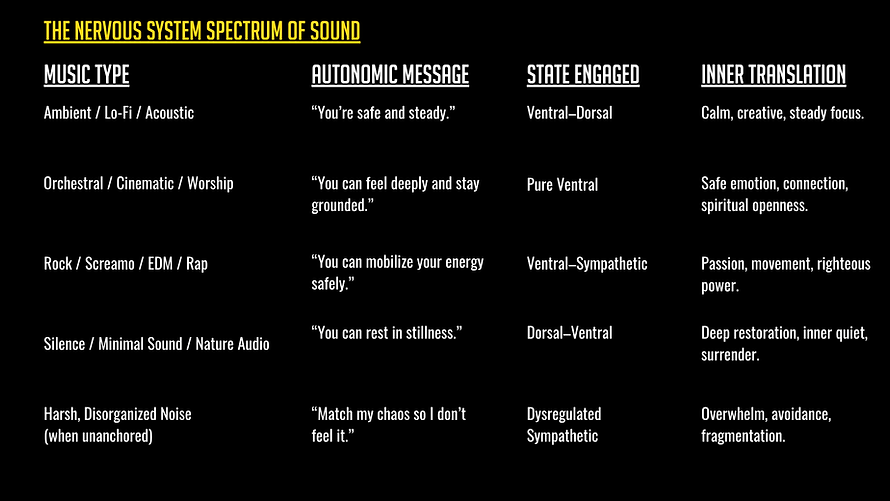
Music as a Mirror
(How Sound Reveals Your Nervous System’s Story)
Your nervous system doesn’t just hear music — it feels it.
Every tempo, instrument, and vocal tone sends a signal: safe, alert, or overwhelmed.
That’s why the music that moves you, relaxes you, or overstimulates you tells a deeper story about your internal landscape.
Music becomes a mirror of regulation — showing you what your body can safely feel, and what it still resists.
What this Reveals
Your musical preferences aren’t random — they’re autonomic adaptations.
-
When chaos feels safe → you found safety through survival and intensity.
-
When silence feels threatening → your body equates stillness with danger.
-
When rhythm feels relaxing → your system trusts predictable patterns.
So the music you can handle right now shows where your nervous system feels at home.
And the music that overwhelms you shows the next frontier of growth.
Growth Is Expanding Your Musical Tolerance
Healing isn’t about forcing yourself into new sounds — it’s about training your body to hold more variety without losing connection.
Ask yourself:
-
What kind of music feels like “home” right now?
-
What genres make me feel tense or restless?
-
Can I stay connected to myself while listening to music that used to overwhelm me?
Example:
You might start with Lo-Fi (steady safety), then graduate to Orchestral (emotional depth), then Rock (controlled power), and finally find peace in Silence (rested surrender).
That’s the nervous system’s version of emotional cross-training.
Practice: The Playlist Experiment
-
Create four playlists: Calm, Deep, Energized, and Still.
-
Label them by state, not genre.
-
Throughout the week, rotate through them and notice:
-
What helps you focus?
-
What helps you feel?
-
What helps you rest?
-
What helps you release?
-
-
Journal how your body responds — breath, heart rate, posture, emotions.
Over time, you’ll literally feel your nervous system gaining range.
The Takeaway
Your playlists are your Polyvagal training ground.
They show you where your system feels safe, what it’s avoiding, and how far you’ve come.
True regulation isn’t silence or serenity —
it’s being able to hear the whole orchestra of life and stay connected through every note.
Polyvagal & Texting: Why Couples Spin Out Over Screens
Texting seems simple — but for couples, it’s one of the fastest ways to trigger miscommunication, anxiety, and nervous system spirals.
Why?
Because texting removes 3 essential cues the nervous system relies on to feel safe:
-
Tone of voice
-
Facial expression
-
Body language
Without these, the brain fills in the blanks — usually with threat.
Why Texting Is a Nervous System Minefield for Couples
When two people are emotionally bonded, their nervous systems are more sensitive to each other. This means lovers trigger each other faster than strangers, both positively and negatively.
Text removes the very signals your body uses to determine:
-
“Are we okay?”
-
“Do they still love me?”
-
“Is this safe or threatening?”
So even a neutral or positive message can be misread as:
-
cold
-
distant
-
dismissive
-
sarcastic
-
attacking
-
“something is wrong”
And once one person’s system gets activated, the other usually follows — a text spiral begins.
The Illusion of Emojis
We try to use emojis to express tone, but:
Emojis are symbols, not somatic signals.
They cannot convey:
-
nervous system state
-
sincerity
-
nuance
-
warmth
-
attunement
-
repair
A ❤️ may land as pressure.
A 🙂 may land as passive-aggressive.
A “…” or delay in response can activate abandonment wounds.
Why Texting Amplifies Triggers in Relationships
Texting is the perfect storm for dysregulation because:
What You Mean What They Read
“I need space to think.” “You’re abandoning me.”
“Can we talk later?” “You’re avoiding me.”
“I’m okay.” “Something is wrong and you’re hiding it.”
Delayed response “You don’t care.”
Short response “You’re angry.”
The nervous system processes absence of cues as danger.
So texting + emotional topics = 90% chance of misfire.
Topics That Should Never Happen Over Text
Any conversation that can activate shame, blame, abandonment, betrayal, or identity-level pain should not be handled through a screen.
Do not use texting for:
-
conflict resolution
-
accusations or clarifications
-
relationship decisions
-
emotional processing
-
trauma-related discussions
-
jealousy or insecurity
-
breakups or reconciliations
-
conversations about sex, trust, or betrayal
-
anything that affects your future together
If it has the power to change the direction of your relationship, it belongs in person, where regulation can happen.
The Polyvagal Rule for Couples & Texting
If the conversation has emotional weight, it requires co-regulation — and co-regulation cannot happen through text.
Because you cannot:
-
hear their tone
-
see their face
-
read their body
-
match their breathing
-
offer or receive soothing
Texting often bypasses connection and jumps straight into interpretation and assumption — which are driven by past wounds, not present truth.
The New Standard for Regulated Couples
Use text for:
-
logistics
-
encouragement
-
affection
-
light connection
-
“thinking of you” messages
-
planning
Not for processing.
If you’re unsure whether a message is “safe to text,” use this filter:
If the nervous system could misread it, it does not belong in text.
This single boundary can prevent 80% of unnecessary arguments.
IV. Embodied Regulation
Even the Ordinary Regulates
When you slow down enough to notice the small things — wiping a desk, cleaning a fan, folding laundry — your nervous system takes a breath too.
Regulation doesn’t just happen in breathwork or meditation; it happens in the mundane moments you’ve been rushing past.
Every gentle, focused act tells your body:
“You’re safe. You can rest here.”
KTL Nugget — Cleaning the Fan (Polyvagal World)
Before I knew about Polyvagal World, cleaning my fan felt like a useless chore — something I’d put off because it didn’t move the needle.
But now I get it: every small act is regulation in disguise.
I’m sitting there with a Q-tip, scraping out dust from tiny gaps I can barely reach, and it hits me — this is what healing looks like.
Bit by bit.
Crevice by crevice.
Clearing out what’s been clogging the system.
The old me only cared about big wins. The new me knows that nervous-system safety is built through micro-moments of order.
The rhythm of your hand.
The quiet focus.
The satisfaction when you see something clean again.
It all tells your body: “You’re safe. You’re steady. You’re in charge now.”
This is Polyvagal World — where wiping a desk, washing a dish, or cleaning a fan isn’t small.
It’s how you train your system to stay grounded in the ordinary.
It’s how you remind your body that life isn’t a storm to survive anymore — it’s a home you get to tend.
And in a world obsessed with productivity — where speed, output, and constant motion are worn like badges of honor — learning to feel safe standing still is the real work.
These tiny, quiet acts — cleaning the fan, rinsing the sink after a meal, folding a towel with presence, watching the steam rise from your coffee — they’re like lifting weights for your nervous system.
Each one strengthens your ability to rest in silence, to breathe in stillness, and to finally realize:
peace isn’t found by moving faster… it’s built by slowing down.
The Flow of Regulation
Balance isn’t about control — it’s about flow. Every time you shift states intentionally (from stimulation to calm, from movement to stillness), you’re teaching your nervous system that it’s safe to move between energies without getting stuck. That’s emotional intelligence in the body.
Example
You play a video game for an hour. Your body gets that mix of focus and mild activation — safe sympathetic energy.
Then you choose to stop. You move to a calmer space, open a book, slow your breath.
Your system down-regulates — safe parasympathetic energy.
Later, you go for a walk — combining calm focus with physical rhythm, integrating what you’ve learned.
That’s the rhythm of a regulated man — not addicted to one state, but fluent in all of them.
Core Takeaway
Over time, your body starts to know when to switch modes.
You stop needing to be “told” what to do by guilt or mental discipline.
Instead, your nervous system begins to self-correct — it wants balance, it wants health.
That’s what it means to live in the flow of regulation.
V. Revelation: The Spiritual Side of Regulation
The Science of Safety and the Spiritual Art of Regulation
“Every moment you choose presence over distraction, you’re charging your soul back to 100%.”
Overview:
Regulation isn’t just about calming down — it’s about opening up.
It’s the bridge between body, mind, and Spirit.
When you regulate your nervous system, you make space for revelation. You stop living in reaction, and start living in rhythm. The body you once fought against becomes the very vessel through which God speaks.
Main Teaching:
When you’re dysregulated, every decision is filtered through survival. You pick what’s fastest, loudest, or most stimulating—because your nervous system is starving for safety. But when you learn how to regulate, everything opens up.
Suddenly, things that used to feel like “a waste of time”—going for a walk, doodling, painting, sitting in silence—become sacred. These aren’t meaningless distractions; they’re regulation portals.
They really are regulation portals—gateways back into capacity.
Think of it like charging your internal battery.
Every time you choose one of those simple acts—walking, doodling, journaling, sitting in silence—you’re plugging yourself back into the source.
You’re restoring the energy that survival drained from you.
Just like a car needs maintenance to perform at its best, your nervous system needs these portals to keep running clean and powerful.
Regulation doesn’t just calm you down; it re-energizes you so you can show up full instead of running on empty.
Practical Examples:
-
Walks: your eyes track the horizon, your breath steadies, your body finds rhythm.
-
Drawing or coloring: micro-focus slows your system, matching movement to breath.
-
Writing: slows cognition, integrates thoughts into clarity.
-
Prayer or worship: activates gratitude and rest, aligning heart rhythm and breath.
Each of these is a charging point for your system — a way to plug back into peace.
Regulation Creates Revelation
When you live in that rhythm long enough, something supernatural happens.
You stop chasing stimulation and start channeling inspiration.
Regulation becomes revelation.
The same nervous system that once panicked becomes prophetic —
a body that no longer blocks God’s voice, but receives it.
Because here’s the truth:
You can’t hear Heaven clearly when your nervous system is in survival.
Your mind might be praying, but your body’s braced for war.
That’s why men who learn to regulate become creative again.
They start to dream again.
They start to see possibilities instead of problems.
Their nervous system isn’t just surviving — it’s collaborating with the Spirit.
Charging the Soul
They really are regulation portals — gateways back into capacity.
Think of it like charging your internal battery.
Every act of regulation — walking, reading, praying, cleaning — is you plugging yourself back into God’s power source.
When you live from that place, you don’t just feel better.
You create better.
You lead better.
You love better.
You stop leaking energy through anxiety, control, and overthinking.
And you start storing energy for wisdom, creation, and connection.
That’s the fruit of safety: clarity.
And clarity is what gives birth to revelation.
The Ancient Rhythm
It’s wild to think: people used to live like this naturally.
Before screens, before constant stimulation, there was stillness — painting, writing, poetry, music.
They didn’t have the language of Polyvagal Theory,
but they knew how to regulate.
They found safety through rhythm, through beauty, through creation.
That’s why so many masterpieces were born in candle-lit silence —
because balanced nervous systems birth innovation.
Their creativity was their regulation.
And when you live this way, you realize:
you don’t need to chase adrenaline to feel alive —
you just need to be home in your body.
Closing Thoughts
Every act of regulation is an act of worship.
You’re not just calming your body —
you’re making room for God’s voice.
You’re building a body that can carry revelation without breaking under it.
That’s the true meaning of being Calm in the Storm.
VI. Polyvagal World in Scripture: The Gospel of the Nervous System
The Story Beneath the Story
The Bible isn’t just a moral or theological record — it’s a nervous system journey told through generations of human bodies learning what safety feels like again.
Every major story — from the Garden to the Cross — reveals the same pattern: connection → rupture → repair → deeper connection.
This is the divine rhythm that Polyvagal Theory names, and the Gospel fulfills.
1. The Garden: Safety Lost
Text: Genesis 2–3
In Eden, humanity lived in pure ventral safety — fully seen, fully known, fully connected. There was no pretense, no armor, no shame.
Then the rupture came.
Shame entered, and with it came the first nervous system shift:
-
“They hid” → dorsal shutdown (disconnection).
-
“They covered themselves” → sympathetic control (self-protection).
-
“Where are you?” → God initiating co-regulation.
The fall wasn’t just moral disobedience — it was the first dysregulated nervous system. And God’s question wasn’t accusation; it was an invitation back into presence.
2. Exodus: From Survival to Safety
Text: Exodus 3–15
Israel’s story begins in dorsal collapse — enslaved, silenced, disconnected.
Then God speaks through Moses: “I have seen your misery… I am coming down to rescue you.”
His voice becomes the regulating tone.
Each plague, each confrontation, awakens dormant sympathetic energy — the body beginning to rise again.
The Red Sea moment is a massive somatic release: centuries of frozen fear finally discharged through song and movement.
“The Lord is my strength and my song.”
(Exodus 15:2)
Deliverance wasn’t just external. It was physiological resurrection — God teaching His people what safety feels like again.
3. Elijah and the Cave: Regulation After Burnout
Text: 1 Kings 19
Elijah goes from fire-calling prophet to suicidal despair overnight.
His body swings from sympathetic overdrive (fleeing Jezebel) to dorsal collapse (lying under a tree wishing for death).
God doesn’t rebuke him — He regulates him:
-
“Get up and eat.” (Physical repair)
-
Rest. (Dorsal recovery)
-
A gentle whisper. (Ventral restoration)
The “still small voice” is God’s ventral tone — the quiet presence that brings the body back to safety.
Regulation precedes revelation.
4. David’s Nervous System Psalms
Texts: Psalms 13, 23, 42, 131
David lives in full emotional range. His Psalms trace the body’s regulation cycles:
-
“Why are You hiding?” → dorsal despair.
-
“How long, O Lord?” → sympathetic protest.
-
“You restore my soul.” → ventral peace.
He doesn’t suppress dysregulation; he sings through it.
His nervous system is his instrument, and worship becomes the practice of regulation — turning panic into presence.
5. Jesus: The Embodied Regulator
Texts: The Gospels
Jesus didn’t just preach peace — He embodied it.
He co-regulated every person He touched:
-
The leper: “Be clean.” (touch restoring ventral safety)
-
The woman with the issue of blood: “Daughter, your faith has healed you.” (naming restores belonging)
-
The storm: “Peace, be still.” (external calm mirroring internal regulation)
-
Peter after denial: shared breakfast, eye contact, forgiveness (ventral repair).
The Incarnation itself is God entering human dysregulation — God in the flesh, regulating us back to safety from the inside out.
6. The Early Church: Safety Restored in Community
2–4, 1 John 4:18
When the Spirit comes, He brings breath and belonging.
-
“They were all together in one place.”
-
Shared meals, shared hearts, shared resources.
-
“Perfect love casts out fear.”
It’s the birth of communal ventral safety — humanity finally exhaling again after centuries of survival.
The Holy Spirit is the divine co-regulator, transforming trauma survivors into a family.
7. Revelation: Safety Eternal
Texts: Revelation 21–22
At the end of the story, threat is gone forever:
“No more death or mourning or crying or pain.”
This is full nervous system integration — no more fight, no more flight, no more freeze. Only presence, connection, and peace.
Heaven is the nervous system at rest in the presence of perfect love.
8. The Birthday Revelation: The Integration Moment
October 30, 2025
Today, during my workout, God whispered something simple but world-shifting:
“It’s time to read again.”
Not to prove, not to defend — to feel.
To read Scripture with a ventral nervous system.
For years, theology triggered me. It put me in sympathetic drive — fight for truth, argue for certainty. When that collapsed, I fell into dorsal shutdown — numb faith, detached prayer, silence that wasn’t peace.
But through this healing journey — through Polyvagal Theory, through separation, through regulating fire — I’ve learned to live from safety again. And today, on my birthday, the two halves finally met: theology and embodiment.
Now when I open my Bible, I don’t hear accusation — I hear invitation.
I don’t study to dissect — I read to reconnect.
The Word that once pressured me now regulates me.
This is the foundation.
This is the house.
The nervous system and the Spirit are speaking the same language — and I finally understand both.
“The Word became flesh.” (John 1:14)
The truth became nervous system.
And safety became sacred.
Closing Reflection:
When you read the Bible from your ventral state, it ceases to be a book about fear, sin, and striving — and becomes the living story of safety, connection, and co-regulation between God and humanity.
This is the Gospel of the Nervous System.
This is what it means to be Calm in the Storm.
VII. Integration: The Journey Home
The Journey Home: From Science to Spirit
You’ve traveled through the full spectrum of Polyvagal World.
You’ve learned the language of your body, the art of regulation, and the sacred science of safety.
Now comes the final step — integration.
This is where it all becomes life.
1. What Integration Really Means
Integration isn’t about memorizing theory — it’s about living safety.
It’s when the things you’ve learned stop being concepts and start becoming your baseline.
It’s the quiet shift from trying to regulate to simply being regulated.
Your body knows the way home now.
It recognizes what connection feels like, what threat feels like, and what peace feels like.
You don’t have to force it — just listen.
That’s the fruit of all this work: awareness without effort.
2. The Whole Journey in One Breath
-
Section I — Foundation: you met your system. You learned your blends and discovered that safety is connection, not calm.
-
Section II — Safety in Motion: you learned to hold fire without fear — to move with energy instead of reacting to it.
-
Section III — Sensory Awareness: you began listening to your body through sound, rhythm, and digital communication.
-
Section IV — Embodied Regulation: you saw that healing hides in the ordinary — that cleaning a fan can cleanse the soul.
-
Section V — Revelation: you learned that regulation opens the door to creativity and divine communion.
-
Section VI — The Gospel of the Nervous System: you saw that Scripture itself is a nervous system restoration story — God co-regulating humanity through love.
And now — here — you bring them all together.
This is where the science becomes Spirit, and the Spirit becomes embodied.
3. Living From a Regulated Identity
When you live integrated, regulation stops being an emergency response.
It becomes your posture.
-
You move through conflict without losing center.
-
You create without burning out.
-
You pray without performing.
-
You rest without guilt.
This is emotional intelligence as spiritual maturity —
to be so at home in your body that heaven feels near in every breath.
“The more I learn to regulate, the more I recognize God’s voice — calm, clear, connected.”
4. The Sacred Cycle
Integration doesn’t mean perfection; it means participation.
Every time you fall out of safety and find your way back, you strengthen the bridge.
You begin to trust that every storm is just another invitation home —
to re-enter presence, to re-embody peace, to remember who you are.
Science gave us language. Spirit gave it meaning.
Together they gave us home.
5. Core Takeaways
-
Regulation = relationship restored.
-
Healing = worship in motion.
-
Safety = the felt presence of God.
-
Breath = prayer without words.
-
Presence = the proof you are free.
6. Closing Reflection
You’ve made it through the storm.
Not by escaping it — but by learning to stay calm within it.
You are no longer just studying Polyvagal Theory.
You’re living it.
You are the bridge between body and Spirit,
science and Scripture,
fire and peace.
“This is what it means to be Calm in the Storm.”