Artificial Intelligence, Embodiment, and the Future of Creativity
- Kurtis Mercer

- May 22
- 5 min read

One thing I realized recently after getting feedback on The Inner Game of Awareness is that a lot of people still see artificial intelligence through a very specific lens.
I was talking to someone yesterday who read a tiny portion of the beginning of the book and immediately said it “sounded AI generated.” And honestly, I appreciated the honesty. I genuinely did. But it made me realize something important:
Most people currently associate AI with regurgitation.
They think of students using ChatGPT to cheat on exams.
People writing fake book reports.
Creators pumping out soulless courses.
Influencers copying motivational quotes.
Business owners generating content they don’t actually understand.
And the truth is?
A lot of people are using AI exactly like that.
They’re collecting information from podcasts, books, gurus, neuroscientists, psychologists, or random creators online… and then throwing all of it into artificial intelligence to create content they haven’t actually embodied themselves.
That’s the key distinction.
Intellectualizing vs. Embodiment
This is something I talk about heavily inside The Inner Game of Awareness.|
A lot of people mistake intellectual knowledge for transformation.
They read books.
Listen to podcasts.
Take courses.
Watch YouTube videos.
Attend workshops.
And all of that is valuable.
But many people unconsciously assume that consuming information means they know the material.
It doesn’t.
Because if you sit down with someone over coffee who only has intellectual knowledge, eventually the conversation starts to break down. They can repeat concepts. They can quote experts. They can say the right words. But once the conversation gets layered, nuanced, emotional, practical, experiential… you start noticing there’s no depth underneath it.
They studied the map.
But they never walked the terrain.
That’s why the quote often attributed to Albert Einstein hits so hard:
“If you can’t explain it simply, you don’t understand it well enough.”
Embodiment is different.
Embodiment means you lived it.
It means the knowledge cost you something.
Late nights. Breakdowns. Failure. Conflict. Loss. Confusion. Humility.
It means you learned the lesson through your nervous system, not just your intellect.
AI Is a Tool — Not the Problem
The issue is not artificial intelligence itself.
The issue is whether the person using it has depth behind what they’re creating.
For me personally, AI has changed everything.
Not because it magically gives me wisdom.
Not because it creates ideas for me.
Not because it replaces creativity.
But because it removes friction between my internal world and external expression.
I’m not naturally a traditional writer.
I’m a speaker.
My brain works through verbal processing, conversation, storytelling, layered thinking, emotion, and reflection. Grammar and punctuation have always slowed me down. Sentence structure can feel exhausting to manually organize.
So now?
I speak into a microphone.
I dictate ideas.
Stories.
Concepts.
Frameworks.
Experiences.
And AI helps structure it into readable form.
That doesn’t mean the ideas came from AI.
It means the translation process was assisted by AI.
That’s a massive difference.
Back in 2018…
Back when I was making YouTube videos years ago, the process felt painfully slow.
I loved creating.
But I hated all the tiny tedious steps surrounding creation.
SEO research.
Titles.
Descriptions.
Tags.
Browser plugins.
Search optimization tools.
Keyword research.
It drained the life out of me.
Now?
AI helps streamline all of that.
I can focus more energy on what I’m actually good at:
Creating. Teaching. Reflecting. Communicating.
That’s why I believe people who completely reject AI moving into the future are going to struggle massively — especially creatives and entrepreneurs.
Not because AI replaces people.
But because it dramatically increases leverage.
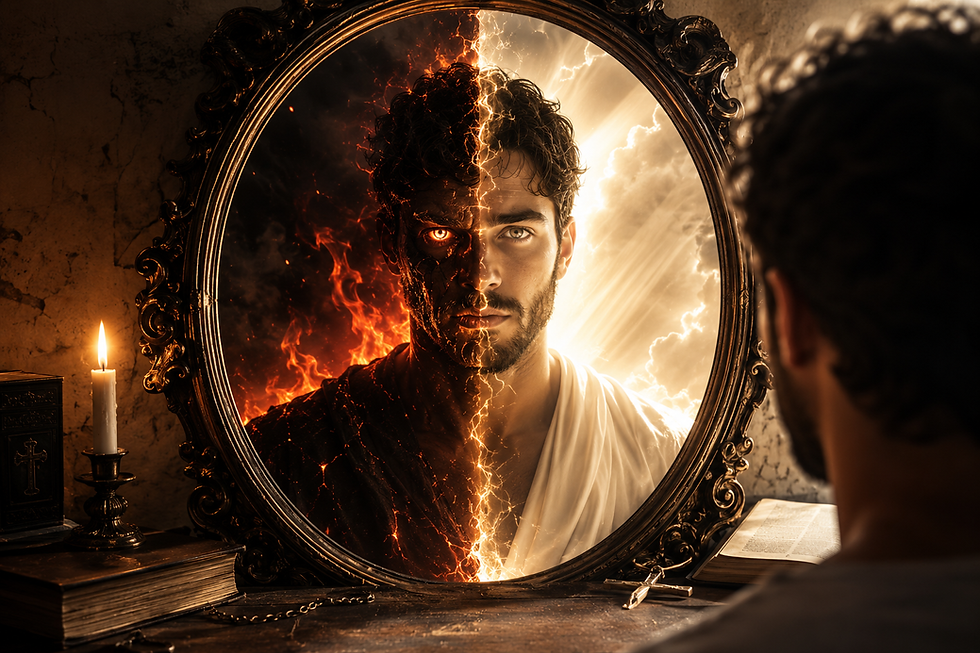
But AI Is Also a Mirror
Here’s the part most people miss.
Artificial intelligence amplifies whatever is already inside of you.
That’s why it’s a double-edged sword.
If someone is manipulative, shallow, dishonest, narcissistic, delusional, or disconnected from reality… AI can amplify that.
And unfortunately, there are a lot of people online creating “AI slop” right now.
Soulless content.
Regurgitated motivation.
Fake expertise.
Artificial wisdom.
That’s real.
But throwing out all AI because some people misuse it would be like throwing out the internet because scammers exist.
The deeper issue is human consciousness.
AI simply magnifies it.
My Own Embodiment Journey
The reason The Inner Game of Awareness exists isn’t because I sat around reading psychology books all day.
Those helped, yes.
But the real transformation came through lived experience.
Marriage conflict.
Emotional dysregulation.
Financial pressure.
Poverty mindset.
Shame.
Anger.
Impulsivity.
Attachment wounds.
Identity collapse.
I had to confront myself.
I had to realize that some of the pain in my life wasn’t just caused by “other people.” It was also coming from patterns inside of me that I couldn’t see yet.
That embodiment process changed everything.
Then the books, podcasts, neuroscience, emotional health training, coaching programs, attachment theory, nervous system work, and psychology all started integrating into something real.
Not just theory.
Lived understanding.
That’s where depth comes from.
The Mount Everest Example
Here’s the simplest way I can explain embodiment versus intellectualizing.
Imagine you wanted someone to guide you up Mount Everest.
Who would you trust more?
The person who:
Read every book about Everest
Studied weather patterns
Listened to podcasts
Watched documentaries
Or the person who:
Actually climbed the mountain
Experienced the altitude
Faced the storms
Learned through trial and error
Reached the summit themselves
Of course you’d trust the person who lived it.
That’s embodiment.
And when someone with embodiment uses artificial intelligence, something powerful happens.
AI becomes an amplifier for lived wisdom.
AI and Human Potential
Artificial intelligence allows people to move faster than ever before.
Ideas can become:
Books
Podcasts
Videos
Courses
Blogs
Businesses
Communities
Movements
And for creatives especially, this changes the game entirely.
AI helps remove bottlenecks between imagination and execution.
But again — it all depends on the person using it.
Because AI reflects the operator.
If your internal world is chaotic, dishonest, manipulative, or disconnected… that will eventually bleed into your work.
But if your internal world is grounded in truth, growth, humility, reflection, and embodiment… AI can become one of the most powerful creative tools humanity has ever seen.
Final Thoughts
Artificial intelligence is not inherently good or evil.
It’s a mirror.
A multiplier.
An amplifier.
And moving forward into the future, the people who thrive won’t simply be the people who use AI…
It will be the people who combine:
embodiment,
lived experience,
wisdom,
self-awareness,
creativity,
and artificial intelligence together.
Because the future doesn’t belong to people who merely consume information.
It belongs to people who can integrate it, embody it, and then communicate it in a way that genuinely helps others grow.
Want to Go Deeper?
👉 Watch the full teachings on YouTube:Kurtis Mercer Coaching YouTube:
🌐 Visit the website to explore articles, book a call, and access more resources:KurtisMercer.com


Comments